What Geologic Process Is Related to Caldera Formation
Home » Volcanoes » What is a Caldera?
What is a Caldera? How Exercise Calderas Form?
Commodity by: , PhD, RPG
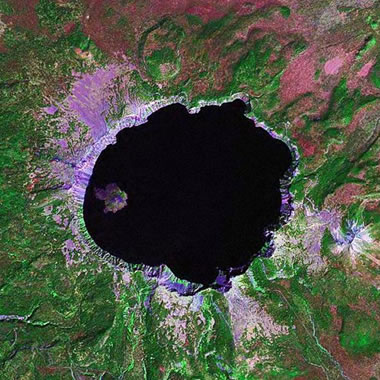
Crater Lake Caldera: A satellite view of Crater Lake, 1 of the globe'south almost famous calderas. Crater Lake formed near 7700 years ago when a massive volcanic eruption of Mount Mazama emptied a large magma bedchamber beneath the mountain. The fractured rock higher up the magma chamber complanate to produce a massive crater over half-dozen miles across. Centuries of rain and snow filled the caldera, creating Crater Lake. With a depth of 1949 feet (594 meters), Crater Lake is the deepest lake in the United states and the ninth-deepest lake in the world. The epitome to a higher place was produced using Landsat GeoCover data from NASA. Enlarge image.
What is a Caldera?
Calderas are some of the most spectacular features on World. They are large volcanic craters that form by 2 dissimilar methods: one) an explosive volcanic eruption; or, 2) collapse of surface stone into an empty magma chamber.
The accompanying image is a satellite view of 1 of the most famous calderas - Crater Lake in Oregon. Crater Lake was formed about 7700 years ago when an enormous volcanic eruption of Mount Mazama emptied a large magma bedroom below the mountain. The fractured rock above the magma chamber collapsed to produce a massive crater over 6 miles across. Centuries of rain and snowfall filled the caldera, creating Crater Lake. With a depth of 1949 feet (594 meters), Crater Lake is the deepest lake in the United states and the ninth-deepest lake in the world.
Collapse Calderas
Collapse calderas course when a large magma chamber is emptied by a volcanic eruption or by subsurface magma motion. The unsupported rock that forms the roof of the magma chamber then collapses to form a large crater. Crater Lake and many other calderas are thought to have formed by this process.
The four-footstep analogy below explains how the Crater Lake caldera is thought to take formed. The video on this page shows a table-summit model of caldera formation. This would be an fantabulous activeness for teachers to practice with their students, or they tin can just show the video using computer projection.
Caldera demonstration: This video shows a didactics activity that conspicuously demonstrates how a caldera is formed. It can be difficult to explain or draw how a caldera forms. This table-top model is a not bad sit-in. Teachers tin can practise this activity with their students, or simply show the video in class using computer projection. Dina Venezky and Stephen Wessells, 2010, Caldera Demonstration Model: U.S. Geological Survey Open up-File Study 2010-1173.
What Causes Explosive Eruptions at Kilauea?
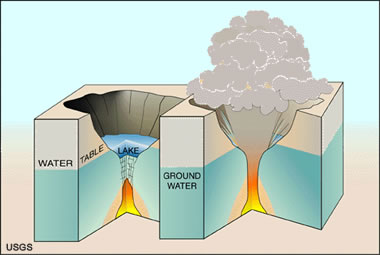
Explosive Eruptions at Kilauea: Many of Kilauea'due south pre-1924 explosive eruptions that produced significant ash deposits probably happened when the volcano's summit crater was so deep that its floor was beneath the h2o tabular array, letting groundwater seep in to form a lake. Whenever magma erupted into the lake h2o, trigger-happy explosions of steam and volcanic gases resulted, fragmenting the magma into tiny ash particles and driving fast-moving, extremely hot ash-laden steam clouds (pyroclastic surges) out of the crater. Image and caption by USGS.
Steps in the germination of Crater Lake Caldera
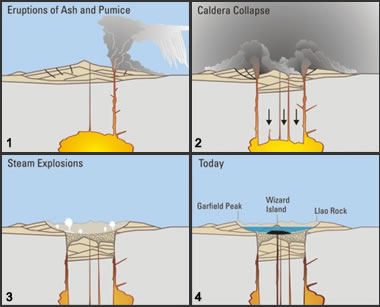
Eruptions of ash and pumice: The cataclysmic eruption started from a vent on the northeast side of the volcano as a towering column of ash, with pyroclastic flows spreading to the northeast. Caldera collapse: As more magma was erupted, cracks opened up around the top, which began to plummet. Fountains of pumice and ash surrounded the collapsing tiptop, and pyroclastic flows raced down all sides of the volcano. Steam explosions: When the dust had settled, the new caldera was 5 miles (8 km) in bore and i mile (1.vi km) deep. Groundwater interacted with hot deposits, causing explosions of steam and ash. Today: In the outset few hundred years after the cataclysmic eruption, renewed eruptions built Magician Island, Merriam Cone, and the primal platform. Water filled the new caldera to form the deepest lake in the United states of america. Figure modified from diagrams on back of 1988 USGS map "Crater Lake National Park and Vicinity, Oregon." Illustration and caption past the United States Geological Survey.
Explosive Calderas
Explosive calderas are formed when very large magma chambers filled with silica-rich melt and arable gas move upwards from depth. Silica-rich magmas have a very high viscosity that enables them to hold gas bubbles under very loftier pressures. As they ascension to the surface, the reduction of pressure causes the gases to expand. When pause-through occurs the outcome tin can be an enormous explosion which blasts away large volumes of rock to form the caldera. Some of these blasts eject many cubic kilometers of magma and rock.
Yellowstone Caldera Chain
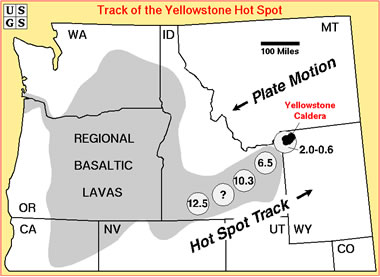
Yellowstone Caldera Chain: The electric current caldera at Yellowstone is the near recent in a series of eruptions that bridge millions of years. The North American Plate is moving due west over a stationary hot spot. As the plate moves, the hotspot produces an enormous eruption (and a large caldera) every few one thousand thousand years. This has produced regional basaltic lavas and a chain of rhyolitic caldera groups (circles, with ages in millions of years) along the track of the Yellowstone hot spot. Image by USGS.
The Yellowstone Supervolcano & Caldera Chain
Yellowstone National Park is world-famous for its geysers and hot springs. Those thermal features are easy-to-observe prove of an agile magma organization beneath the Park. This magma organization has produced some of the largest volcanic eruptions in Earth's history - eruptions then big that they have been called "supervolcanoes." 1 of these eruptions produced a caldera about fifty miles beyond that underlies most of Yellowstone National Park.
The Toba Explosive Eruption
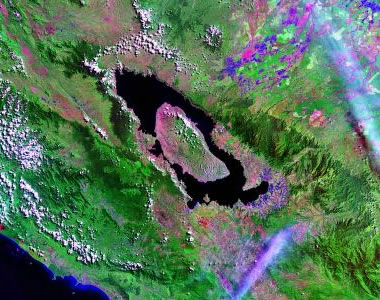
Toba Caldera: Landsat GeoCover image of the caldera formed by the Toba Supervolcano. It is now the world'south largest volcanic lake. The image in a higher place was produced using Landsat GeoCover data from NASA. Overstate image.
The Toba Supervolcano
Well-nigh 73,000 years ago, the eruption of Toba on the isle of Sumatra, Republic of indonesia produced what is believed to be the largest explosive eruption on Earth in at to the lowest degree the past 25 meg years.
The Toba boom is believed to take deforested much of central India - almost 3000 miles from the eruption site. The blast is thought to accept ejected well-nigh 800 cubic kilometers of ash into the atmosphere, producing a crater that is 100 kilometers long and 35 kilometers broad. The crater is now the site of the globe'southward largest volcanic lake.
Compare Explosive Eruptions
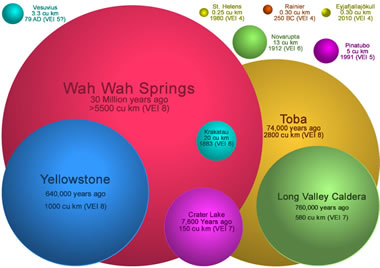
Volcanic Explosivity is a method of comparing the size of explosive volcanic eruptions by estimating the volume of material ejected. Our article on the "Volcanic Explosivity Index" gives a graphic comparison of the Crater Lake, Toba, and Yellowstone supervolcanoes.
Calderas on Other Planets
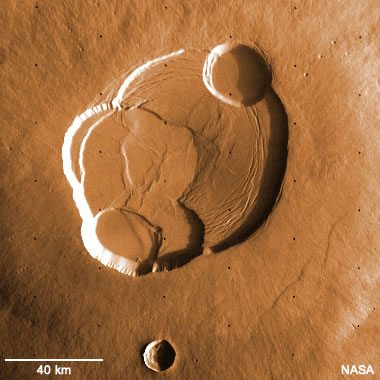
Calderas on Other Planets: Complex caldera at the summit of Olympus Mons Volcano - a shield volcano that is the tallest characteristic on Mars. This caldera is very like to the caldera complex at the summit of Earth's largest shield volcano - Mauna Loa Volcano on the island of Hawaii. Image by NASA.
Snow-Covered Calderas on Hawaii
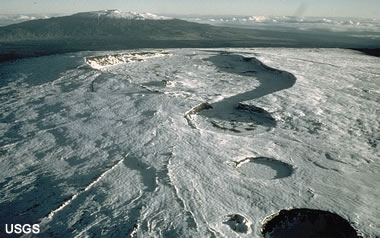
Mauna Loa Volcano: Snow-covered Moku'aweoweo Caldera atop Mauna Loa shield volcano (Mauna Kea in background) on the isle of Hawaii. The caldera is 3 x 5 km across, 183 m deep, and is estimated to have complanate between 600-750 years agone. Several pit craters along the upper southwest rift zone of Mauna Loa (lower correct) also formed by collapse of the ground. Paradigm and explanation by USGS. Overstate image.
Aniakchak Caldera, Alaska
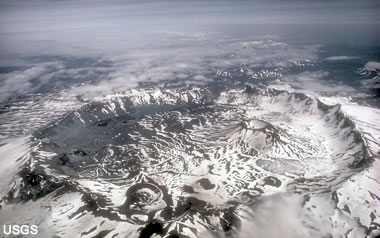
Aniakchak Caldera in Alaska: Aniakchak Caldera, located in the Aleutian Range of Alaska, formed during an enormous explosive eruption that expelled more than than 50 kmthree of magma about 3,450 years agone. The caldera is 10 kilometers in bore and 500-1,000 meters deep. Subsequent eruptions formed domes, cinder cones, and explosion pits on the caldera flooring. Enlarge image.
Notice Other Topics on Geology.com:
 Rocks: Galleries of igneous, sedimentary and metamorphic rock photos with descriptions. |  Minerals: Data about ore minerals, jewel materials and rock-forming minerals. |
 Volcanoes: Articles virtually volcanoes, volcanic hazards and eruptions by and nowadays. |  Gemstones: Colorful images and articles most diamonds and colored stones. |
 General Geology: Articles about geysers, maars, deltas, rifts, salt domes, water, and much more than! |  Geology Shop: Hammers, field bags, manus lenses, maps, books, hardness picks, aureate pans. |
 |  Diamonds: Acquire about the properties of diamond, its many uses, and diamond discoveries. |
Source: https://geology.com/articles/caldera/
0 Response to "What Geologic Process Is Related to Caldera Formation"
Post a Comment