Everything That Happend Will Happen Again Galactica
'Information technology'southward funny, isn't information technology? We're all God, Starbuck. All of u.s.. I come across the love that binds all living things together.'
Leoben Conoy, 'Flesh and Bone' (i.08)[1]
Break text
One of the curious features of series television set is its incompleteness. Where a novel, a painting or even a play arrives fully formed, its early drafts or preliminary sketches subsumed into a complete and unified whole, boob tube shows are made upward every bit they get along, evolving along the way. Sometimes the changes are large, and discontinuous; sometimes they are incremental, matters of emphasis and shifting focus, all the same either way they ensure that equally the years pass no television show is always the show information technology started every bit.
Information technology's interesting therefore, as SciFi Channel'south Battlestar Galactica enters the second half of its fourth and final season, to wonder how clearly Ronald D. Moore and David Eick, the creators of the 2003 airplane pilot mini-series foresaw the way the show would speedily exceed the terms of its own conception, developing from an already interesting and original take on genre television set into something far richer and stranger.
Watching those early episodes once again, it's hard not to see the way the prove already pushed confronting the conventions of scientific discipline fiction tv set. Laser rifles and aliens are notably absent, in their place is a hereafter – or possibly a past – that looks surprisingly like our present. Bars for the almost function to the decks and corridors of Galactica herself, the show's claustrophobic interiors and silent spilling space battles eschew the tendency of most science fiction to strive towards the cinematic; in their place the bear witness offers a vision of war more familiar from Saving Private Ryan or Band of Brothers, an often hallucinatory collage of handheld photographic camera and jump-cutting editing[two]. Even the swelling orchestral score that has defined scientific discipline fiction on the screen since Star Wars is gone, replaced by Comport McCreary's hauntingly minimal soundscapes of countless taiko drums and wind chimes, music that sounds more than similar the Philip Glass of Akhnaten than John Williams (and indeed, on at to the lowest degree 1 occasion, really is Philip Glass)[iii].
Yet confronted with Battlestar Galactica'southward increasingly haunted and haunting third flavor, and the extraordinary first one-half of its 4th, their vision of ii societies deranged by war and shadowed by visions of both conservancy and destruction, it is still difficult to believe that the strange, troubling and often beautiful creation the show has get was in its creators' minds from the beginning. For although the intense and often visceral edge that marks the early episodes remains, it has become just one chemical element in a far larger narrative, a narrative that offers a powerful, and ofttimes deeply unsettling exploration of contemporary anxieties about war and terrorism and the capacity of violence and trauma to unmake society and individuals, likewise as an intensely disquieting meditation on the shifting boundaries betwixt humanity and inhumanity, u.s.a. and them, Homo and Other.
Suspension Text

Break Text
For those who grew up in the 1970s and 1980s as I did, the premise of Battlestar Galactica is likely to be familiar from the original serial of the same proper noun. Humanity, spread across the twelve planets of the Twelve Colonies, is almost annihilated in a surprise attack by the Cylons. In the chaotic aftermath of the attack a canaille fleet of refugees manage to escape and, banding together under the protection of the final remaining battlestar, embark upon a search for the mythical thirteenth colony, World.
The original series is ane of the military camp classics of 1970s sci-fi television. 1 part Star Wars, one office a homage to its creator, Glen A. Larson's Mormon heritage, it survived a single season, producing twenty-four hours of television and a universally derided spin-off series, Galactica, 1980, in which the survivors finally establish World, and began secretly preparing the inhabitants for the arrival of their cousins from the stars.
Yet for all its woozy 1970s new age trappings and echoes of Erich von Daniken ('At that place are those who believe that life here began out in that location, far beyond the universe, with tribes of humans who may take been the forefathers of the Egyptians, or the Toltecs, or the Mayans.. . . . Some believe that there may however be brothers of human who even now fight to survive somewhere beyond the heavens, intoned Patrick Macnee over the credits of the original show )something of the original series wove its fashion into the pop consciousness, as did its i enduring image, that of the unmarried reddish Cylon heart, moving inexorably from side to side in the visor of their chrome-plated helmets.
The revisioned Battlestar Galactica recasts the concept of the original serial in contemporary terms. No longer an expression of Cold State of war paranoia, the story of the attack and the fleet'south desperate flight is grounded in early on twenty-first-century, post-9/11 anxieties about terrorism and the pass up of the W. The starry-eyed explorers of the original series take become the last remnants of a shattered social club quite literally struggling to survive. No longer united under the benevolent gaze of Lorne Green's original Commander Adama, the fleet is now divided and suspicious, haunted by political dissent and religious extremism Edward James Olmos' Adama can exercise picayune to incorporate. Even the physical universe is altered, no longer a place of wondrous ice planets and shimmering lights, but a cold and unforgiving emptiness, cleaved simply by isolated planets devoid of all merely the simplest organic life.
Yet it is the Cylons who are the most haunting creation of the revisioned series. Where in the original serial they are a faceless race of lizard-like aliens, in the revisioned serial they have been reborn equally artificial beings, some, replicant-like, duplicate from ourselves and identified by their model numbers (Two, Three, Six, Eight), others, such as the robotic centurions and Cylon raiders, intelligent biomechanical or cybernetic creatures possessed of an autonomy limited by inbuilt constraints.
Created not in some conflicting lab merely, as the opening credits inform united states of america in a terse, telegraphed series of bullet points, 'The Cylons Were Created by Man. They Rebelled. They Evolved. At that place Are Many Copies. And They Have a Plan'[4], by humans, the Cylons are a deeply troubling presence. Simultaneously Rilkean angels, immortal beings lit past the cognition of a hidden but revelatory beauty, and uncanny, ofttimes profoundly disturbing simulacra of human beings, they are at in one case similar but unlike, manufactured yet alive, Human notwithstanding profoundly Other.
Suspension Text

Break Text
Technically speaking of form, the new Battlestar Galactica is neither a continuation of the original series nor a remake. Many narrative elements are retained, non least the names and call signs of fundamental characters such as the armada's commander, William Adama, his Executive Officeholder, Saul Tigh (Michael Hogan), Adama's son, Apollo (Jamie Bamber), and the narcissistic scientific genius, Gaius Baltar (James Callis). Others, such as Katee Sackhoff's Starbuck, Grace Park'south Boomer and Michelle Forbes' Admiral Cain, are regendered reflecting the altered gender relations of the evidence's war machine, an organisation in which men and women fight, launder and slumber together (even the toilets are unisex). At least two, Boomer and Tigh, accept too been transformed into Cylons, in both cases as sleeper agents, initially unaware of their ain identity[5].
All the same other elements are altered. In the opening episode of the miniseries (M.01) we are informed that xl years have passed since the armistice that ended the war between the humans and the Cylons, forty years in which the Cylons take remained invisible beyond the demarcation zone. The Galactica herself, pride of the armada in the original series, is now an ageing relic scheduled for decommission, destined to serve every bit a museum.
Thus the revisioned series is placed in a universe in which many of the elements of the original series remain, present still absent. The war of 40 years earlier is presumably the same war in which the original series took place, notwithstanding the attack itself lies in the future, not the past. The prehistory of the original serial intrudes, both every bit cultural memory and in specific appropriations and allusions, nevertheless the show is not spring by information technology in any way[6].
The revisioned series is explicitly mythic, invoking sources as disparate equally The Aeneid, The Book of Mormon, Exodus and Paradise Lost, too as suggesting other, more than mystic parallels in the Zodiacal names of the Twelve Colonies (Caprica, Sagittaron, Gemenon and so on) and the idols and rituals of the Colonials' polytheistic religion. Like the playful appropriation of scientific discipline fictional tropes such as the term 'skinjobs' to describe the replicant humanoid Cylons from Ridley Scott'due south Blade Runner (in which Olmos also appeared) and the spectral images of the Cylon Hybrids that control the Cylon Basestars lost in waking dreams like the Delphic precogs in Steven Spielberg's Minority Written report, or the more subtle incorporation of sacred texts and language (Kobol, the name of the planet from which the humans fled prior to the founding of the Twelve Colonies, means 'Heaven' in Persian, while the show'due south melancholy theme music incorporates a Hindu Mantra)[7], these mythic elements are highly suggestive, generating parallels and allusions while simultaneously denying easy or reductive correlations. It is a process fabricated more than powerful by the repeated proffer that the events depicted in the narrative are part of some larger whole (not for nothing are we told the Cylons 'Have a Program' in the opening credits), some cycle of time in which past and future are merged and which, in the words repeated by those Cylons privy to the secrets at the show's core, 'All of this has happened earlier, and volition happen again'[8].
This blurring of the familiar and the unfamiliar is a narrative strategy Battlestar Galactica likewise employs to anchor its political subtexts. For all that its contemporary political resonances are deep, taking in anxiety about apocalyptic terrorist attacks, the erosion of ceremonious club by the military, torture and religious extremism, there is seldom whatever easy correlation between events in the series and events in the existent world. This is a strategy powerfully exemplified by the events of the showtime four episodes of the third series. Post-obit the discovery at the end of the second season of a planet capable of supporting human being life, and Baltar'due south defeat of President Roslin (Mary McDonnell) in the first free elections held after the assail, much of the fleet abandons their ships to settle on the planet, at present called New Caprica, simply to find themselves, in a dramatic reversal of fortune, living nether Cylon occupation.
With Galactica gone, the colonists are left undefended, forced to resist the Cylons in any way they tin can. Some, like Baltar, have lilliputian selection but to work with their Cylon masters; others refuse to submit, joining a growing armed insurgency. Every bit the Cylon regime resorts to ever more than brutal tactics to control the insurgency, the methods of the insurgents themselves grow more than farthermost, culminating in a series of suicide bombings intended to impale Cylons and members of the Cylon-directed man constabulary.
Office of a broader destabilisation of the binary moral gild of us and them, right and wrong, Human and Other implicit in the show'due south formulation, these episodes do not merely undermine the piece of cake identification between insurgent and terrorist, merely past explicitly invoking the retentiveness of quisling governments such as Vichy, propose the simplistic historical parallels often drawn between the state of war in Iraq and the 2d Globe War are far less comforting than they are usually causeless to exist.
Break Text

Break Text
This sort of destabilisation is of grade the indicate and power of scientific discipline fiction, withal Battlestar Galactica deploys it with specially unsettling results. In 'Flesh and Os' (ane.08), a Cylon agent is found within the human fleet. Convinced its information volition be worthless, Commander Adama argues it should exist thrown out an airlock but President Roslin, who has encountered the model in a dream, disagrees, and insists the amanuensis, a Two known as Leoben (Callum Keith Rennie), be interrogated.
Starbuck is assigned the task of interrogating the convict Cylon, a task she takes to with agonizing zeal, brutally beating Leoben until at terminal President Roslin interrupts. Seemingly appalled at what she has found, President Roslin demands to know what is going on. Unabashed, Starbuck responds, 'It's a machine, sir, there'south no limit to the tactics I can use.'
It is a sequence that is disturbing for a number of reasons, not the least of which is the fact that none of the characters involved evince any reservations about the use of torture. The question of rights and wrongs is not debated, nor is there any suggestion the characters regret their actions. Indeed despite her intervention in the interrogation, and in directly breach of her ain offering of amnesty, President Roslin herself orders Leoben exist flushed out an airlock but moments after he provides the information she seeks.
At one level these instances of brutality on the part of the man characters are of a piece with the recurrent suggestion that the Twelve Colonies may have been a less than ideal social club, for all its autonomous trappings. When in 'Bastille Day' (one.03) it is discovered the political anarchist and terrorist Tom Zarek is incarcerated on a prison transport ship within the fleet, Apollo admits to having read his books at university, despite them being banned (mayhap seduced by the neatness of the idea, the series toys for a time with the notion that Zarek, played past Richard Hatch, who portrayed Apollo in the original serial, might serve equally a mentor of sorts to the revisioned serial' version of his former self). In another episode, 'Hero' (3.08), we learn the military may have provoked the Cylon attack with unauthorised missions over the demarcation line agreed in the treaty of forty years earlier. And while its verbal nature is left cryptic, the administration in which President Roslin served before the attack seems to have been both politically inept and surprisingly fell: in a scene set but hours earlier the attack President Adar demands Roslin'south resignation considering she has managed to defuse a instructor's strike Adar had planned to intermission upwards with troops in gild to provide an case to other groups seeking to sway the government in like ways.
The ambivalence these glancing references creates is left unexplored. Indeed given that the serial is predicated upon unthinkable grief and loss, Battlestar Galactica provides picayune in the mode of backstory (and on those occasions it does, i ordinarily wishes information technology had continued to err on the side of silence). The vision of space it creates, its emptiness and black, is quite literally a place of expiry, a fact reinforced by the recurring device of characters being diddled out airlocks. With a few exceptions we know side by side to nothing of the lives of the characters earlier the attacks: sometimes we glimpse photographs, occasionally names are mentioned, and on several occasions nosotros see the galleries on Galactica's lower decks where, in a haunting reminder of the message boards that sprung upward in New York in the days after September 11, the crew have pinned pictures and letters and other memorabilia of the lost, only by and large the show inhabits a earth where the by has been, quite literally, obliterated.
Interruption text
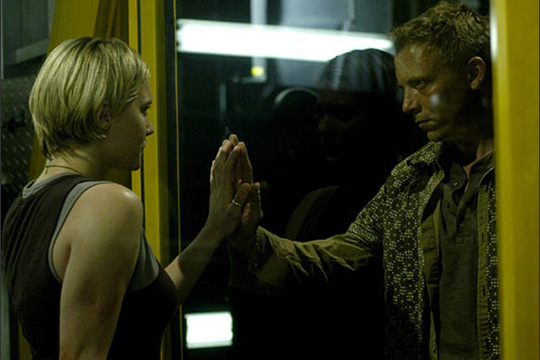
Starbuck (Katee Sackhoff) and Leobon Conoy (Callum Keith Rennie)
Break text
Yet the implications of the events depicted in 'Flesh and Bone' run far deeper than their uncomfortable reminders of Abu Ghraib and the Bush administration'south prosecution of the state of war on terror. While the human characters see the Cylons every bit inhuman, genocidal machines devoid of feeling or identity, the viewer has already come up to see them not as an implacable Other, but as something both less and more familiar. For all that he does not fear death, Leoben feels hurting, fear, hunger and, nearly unsettlingly, professes ecstatic spiritual belief. 'I see the patterns,' he tells Starbuck, in an eerie glimpse of what Cylon consciousness might be like, 'I know that I'm more than than this trunk, more than this consciousness. A role of me swims in the stream but in truth, I'm standing on the shore. The current never takes me downstream.'
In 'Mankind and Bone' and elsewhere, much of the pleasure of Leoben comes from Callum Keith Rennie'due south disconcerting performance. With his scraggy pilus and battered blond looks he most resembles some cracked, streetwise prophet, a man whose eyes see beyond this world, however whose sudden shifts in mood, from kindness to violence and psychological game-playing simultaneously suggest something dangerously mercurial. By dissimilarity the Starbuck of 'Flesh and Bone' is a adult female swaggeringly certain of her own convictions, unwilling even to entertain the possibility that Leoben's suffering might be more than imitation.
The result is an encounter that blurs the stardom between Human and Cylon upon which the show is predicated. For past refusing to concede Leoben's humanity, Starbuck – and by extension Colonial society every bit a whole – is dehumanised, becoming, in an unsettling reversal, precisely the thing she seeks to destroy[9].
The boundary betwixt human and Cylon has already begun to blur before the scenes with Leoben. Nosotros have learned Cylons are biological replicas of human beings, nigh indistinguishable even at a cellular level[x], as well as encountering at least two Cylons (both Eights), the Sharon known every bit Boomer and the Sharon assigned to brood with Helo on Caprica, who not but resist their programming, simply also feel conflicted by human love, want and loyalty. Likewise we have been offered many disquieting images of human cruelty, and of the horrors of war more generally. (In the episode 'Flying of the Phoenix' (2.09) we witness a squadron of Vipers massacre hundreds of disabled and defenceless Cylon raiders. While the pilots and Galactica's bridge coiffure whoop and cheer, the viewer is gratis to explore other, less comfy reactions.)
Yet it is not until the heart of the show'southward second season, and what may well stand up as its finest episode, 'Pegasus', that the viewer perceives only how unclear the distinction between human and Cylon has become. After surviving for more a year on the run, Galactica and the civilian fleet run into another Battlestar, the Pegasus, which has also managed to survive the assail upon the colonies. Just the initial jubilation over finding other survivors apace gives way to ailment. Pegasus commander Admiral Cain and her crew have become instruments of total war, loyal only to themselves and rejecting all moral constraints upon the prosecution of their cause.
The parallels with the Bush assistants's state of war on terror are evident, not to the lowest degree in Cain's barely restrained contempt for President Roslin, and the semblance of civilian government that endures in the fleet ('The Secretary for Education?' Cain asks Adama incredulously after her first interview with him and President Roslin). But it is not the frighteningly clearly fatigued portrait of the corrupting nature of power unchecked by ethical constraints that gives the episode its thematic heart (in some other of the series' uncomfortable reversals President Roslin and Adama eventually agree the simply way to comprise Cain is to corrupt themselves, and murder her) but the revelation that Pegasus has a Cylon prisoner in her brig.
When Baltar examines the prisoner and extracts what information he can, he discovers a Six (Tricia Helfer), a model he has been in love with since before the attack on the Colonies, she is catatonic and immobile, her body displaying the marks of repeated brutality, torture and sexual assail.
The discovery is deeply disturbing, for both Baltar and the viewer, simply it is the post-obit scenes that complete the reversal of roles that is prefigured in 'Flesh and Bone'. Unbeknown to Adama and President Roslin, Cain orders her intelligence officer, Lieutenant Thorne, to interrogate the Eight known equally Sharon (Grace Park) who, having betrayed her race to assist the stranded Helo (Tahmoh Penikett) escape Caprica is now held in Galactica's brig. In a series of viscerally agonizing scenes that cut between an off-duty drinking session on Galactica'south flying deck and Galactica's brig, nosotros circle inwards, watching Thorne arrive in Sharon's jail cell (constructed, in a visual echo of Guantanamo Bay's belongings pens, of wire mesh inside a larger cargo bay), hear Pegasus crew boasting almost their handling of the Half-dozen in their brig, encounter Sharon'south uncertainty turn to starting time to concern and and then terror as Thorne and the troops with him force her confront down on her bed and rape her.
Break text

Admiral Adama (James Lee Olmos) and Saul Tigh (William Hogan)
Break text
No incertitude this game of shifting sympathies, and growing doubt about the boundaries betwixt the human and the Cylon Other would be less effective if it were not embedded in Battlestar Galactica'southward broader involvement in exploring the capacity of war and trauma to derange societies. Implicating information technology in the testify's relentless down screw transforms what might be an engaging diversion into something far more than important, connecting the question of the relationship between the Man and the Cylon Other to the question of the survival of both.
In this respect Battlestar Galactica presents a vision of decline that is virtually unique in series television, its iv seasons non charting humanity's triumph over arduousness, but the alarmingly rapid unravelling of what is left of human social club. This lone would make for confronting viewing, yet the show goes farther, weaving its depiction of this process into a grander mythic narrative.
In quantitative terms this procedure is charted in the number that flashes upward at the terminate of the opening credits of each episode recording the number of survivors, it ticks ever down from its first reading of 49,998, sometimes slowly, sometimes-as in the beginning survivor count later the escape from New Caprica-drastically, simply always downwards, reaching, by midway through the fourth season, a mere 39,685.
In more human terms it is as well visible in the gradual fraying of the fleet itself. Episode by episode the cost in lives weighs more heavily upon the characters, in particular the fighter pilots who are the front end line of defence force. Although the men and women of Galactica are the heroes of the piece, the testify has few illusions about the reality of armed forces life. With the exception of Apollo and a few others, Starbuck and the other pilots are ambitious risk-takers, and there are more than than a few scenes that remind the viewer of the violence and dehumanisation that is a necessary part of military life. Simultaneously though we are constantly reminded that they are, for all their faults, human beings, and of the psychological toll of their responsibilities. Also the many scenes of dress uniform ceremonies that occur in early on episodes quickly fade, anniversary eroded by the need to survive.
In this respect Battlestar Galactica often subverts one of the basic tenets of serial television. For rather than accepting that characters should, for the most part, remain constant over time, information technology repeatedly places them in situations from which they can simply emerge radically and irreparably altered, a procedure that is most axiomatic in the episodes set during the occupation of New Caprica. Yet while all the characters are implicated in this ofttimes brutal process of psychological and social disintegration, growing increasingly embittered and damaged as the series proceeds, it is in the person of President Roslin that the procedure is most starkly fatigued.
President Laura Roslin, and indeed the entire notion of a surviving noncombatant regime, is i of the masterstrokes of the series every bit a whole. The one-time secretarial assistant for educational activity, she assumes the presidency of the Colonies later on the forty-2 members of the regime ahead of her neglect to written report in line with emergency protocols. A former schoolteacher, and initially regarded equally a soft-headed inferior member of a government-Adama himself admits to non having voted for her: 'President Adar was an idiot,' he remarks at ane bespeak-President Roslin assumes the reins of ability essentially unknown and little-respected. At first her chief concern is preserving lives, but by the first episode of the first series, '33' (1.01), she is prepared to give the order to destroy a transport conveying 1500 civilians because she believes a Cylon amanuensis on board threatens the unabridged fleet. This blooding begins a journey that sees President Roslin grow into a hawk of such swift brutality she unnerves fifty-fifty Adama (when, in 'A Measure out of Conservancy' (3.07), Roslin is offered a means to destroy the Cylons forever she does not blink at genocide).
Yet this transformation is not without its costs. Past the fourth series, haunted by visions from the chamalla extract she has been taking in an endeavour to stave off the spreading cancer within her, President Roslin experiences a long hallucination in the moments between hyperspace jumps in which she is confronted with just how removed from human feeling she has become, unable to honey, unable even to feel (the episodes of the first one-half of the fourth flavor likewise dangle the possibility that Roslin is herself a Cylon).
Nor is this focus on the deranging effects of state of war upon societies is non limited to Battlestar Galactica'south portrait of man society. Although in the early on episodes Cylon society remains essentially inscrutable, by the second and third series it is less then, as the series explores the growing angst in Cylon lodge engendered by the war. This procedure really begins with 'Downloaded' (ii.eighteen), which is set not amid the human characters only amid the Cylons on the at present-irradiated and largely ruined Caprica.
Prior to 'Downloaded', the viewer'south contact with fully functioning Cylon characters has been limited to encounters with individual agents, such equally the Leoben in 'Flesh and Os' or the Three known as D'Anna in 'Terminal Cutting'. The 3 continuing presences in the first and second series-the Half dozen who appears to Baltar in his tortured visions; Boomer, whose horrified realisation of her Cylon nature occupies much of the first flavour and culminates in its shocking finale; and the Viii known as Sharon who helps Helo escape from Caprica-are all either unaware of their true identity or separated in some manner from the bulk of Cylon lodge.
'Downloaded' focuses on two Cylons already encountered in very dissimilar circumstances. The first is the Half dozen who used Baltar to access the Twelve Colonies' defense force networks; the second is Boomer, who, having been killed after her attempt to assassinate Adama, has now downloaded and been reborn. Both are hailed equally heroes by their Cylon brothers and sisters. All the same despite this both are struggling to reintegrate into Cylon society. Boomer, still horrified by the discovery of her truthful identity, exists in a state of existential rage and despair, while the Half-dozen is haunted by the cognition of her part in the deaths of so many billions as well as by her honey for Baltar.
Break text

A Three (Lucy Lawless) wakes in a resurrection pod
Break text
The question of individuality and what it might mean haunts 'Downloaded', as well as later episodes focussing on Cylon characters (by the fourth flavour the Cylons are frequently referred to in the singular, every bit 'the Cylon', implying a tacit understanding of the unified and collective nature of Cylon club). Only like the images of a San Francisco populated past alien replicants of its population in Philip Kaufman's 1978 motion picture Invasion of the Bodysnatchers, in that location is something profoundly unsettling well-nigh the idea of a society inhabited past duplicates (perhaps the more so in 'Downloaded' because the Cylons are engaged in the process of re-creating the cities they destroyed in the attack, engaged in some unexplained attempt to reproduce the homo earth then recently extinguished)[xi].
Yet as we come to empathise more about Cylon society information technology becomes clear exactly why Caprica Vi and Boomer's resistance to reintegration poses a threat to the Cylons. Cylon society is collective, a unit in which decisions are made by the group, the models voting as blocks, and the whole acceding to the wishes of the majority. Individual 'skinjobs' seem to be within and outside some sort of hive mind, sharing memories and experiences yet still individuated. To deny the group is therefore to deny the whole, a violence of a profound and about unimaginable kind.
In this respect the Cylons (or Cylon) are a disquieting creation, uncanny copies both of each other and of their human creators. At once man and not, alive yet undying, created beings that both simulate and feel emotion, desire, hurting, their presence drives a radical instability of meaning, 1 that echoes precisely the instances of doppelgangers and simulacra that Freud describes as instances of the uncanny[12] (the mantra of the Cylons, 'All this has happened before, and will happen again', might also be seen equally another example of this Freudian blueprint of recurrence, or indeed of that other nearly uncanny sense of repetition, déjà vu).
This strangeness is given its most powerful expression in the scenes and episodes aboard the Cylon basestars in Seasons Three and Four. In contrast to the relatively banal simulation of human social club glimpsed in 'Downloaded', these episodes afford a glimpse of what information technology might be to be Cylon. Moving silently through space in their cute, geometric Basestars, the immortal Cylons seem to exist both within and outside fourth dimension, passing their existences in meditation, and release into the whole.
It is this unity the Caprica Vi and Boomer'southward resistance threatens, first by its very nature and later, more than directly, past their conclusion to impale a fellow Cylon in order to prevent her from taking the life of a human being resistance fighter. In then doing they spark a series of events that lead first to the doomed attempt to live alongside the humans on New Caprica, and finally to the schism and ceremonious war that divides Cylon society in Season Four.
Such a course is the fulfilment of the Oedipal conflict that begins the series. It is the wages of the Cylon's original sin, yet information technology is also a manifestation of the serial' preoccupation with the effect of trauma upon societies and the blurring of the 2 species. Now they are in conflict their fates are necessarily entwined. The two are now destined to become one, or perish.
Interruption text

Sol Tigh (Michael Hogan) interrogates Boomer (Grace Park)
Pause text
It volition exist interesting to discover exactly how Battlestar Galactica'south producers intend to resolve the remarkable spider web of narrative and thematic complexities the series has created over the past four seasons in the ten episodes that remain. Making sense of the many competing allusions and expectations they create is likely to show challenging, not least considering any resolution will need to fulfil the demands of the words that have haunted the series, 'All of this has happened before, and will happen over again.'
But in a way the path is already prepare and understood. In the terminal episode of Battlestar Galactica's 3rd flavor, in the climactic scene of Baltar's trial for crimes confronting humanity, Apollo gives an impassioned speech calling for his amortization. As he speaks he gropes towards the reason so many are assault killing Baltar, a homo he and many others detest.
'Because you're weak,' Apollo says 'Considering you're arrogant … Because y'all're a coward, and we the mob, want to throw you out of the airlock because yous didn't stand upwardly to the Cylons and go yourself killed in the process. Yous should accept been killed back on New Caprica, merely since yous had the temerity to live, nosotros're going to execute you.'
But as Apollo speaks we see him begin to empathize the answer to the question he has been struggling to articulate. 'This case is built on emotion, on anger, bitterness, vengeance. But most of all, information technology is built on shame … And we're trying to dump all that guilt and all that shame on i man and and then flush him out the airlock, and hope that only gets rid of it all. So that nosotros can alive with ourselves.'
It is a cathartic moment in more ways than one. For Apollo, who has resigned his committee and had his father disown him in lodge to defend a man both hold in contempt, it signals a moment of recognition and clarity of a sort he rarely enjoys.
Merely it also signals a deeper catharsis, the implications of which are non clear to those present, just which achieve into the eye of the show. For in recognising that Baltar, the cast out, the abject, must exist admitted dorsum into the fold, Apollo articulates the possibility of resolution of the deeper conflict that gives the series breath, that betwixt humanity and the Cylons, creatures that were one time their children, just rose against their parents in an act of Oedipal genocide, possibilities that come to be explored in the show's final season. For in the cease there is no us and them, no homo and Other. We are them, and they are u.s.. And all of this has happened before, and volition happen once again.

Starbuck (Kara Thrace)
Break text
Notes:
i In the interests of clarity, episodes are identified by the series and episode numbers independent in their product numbers. Thus episode 4 of series 2 is denoted by the number 2.04. In keeping with this organization the telemovie Razor, while aired as a separate stand-alone episode, is assumed to form the first 2 episodes of Series iv (4.01 and 4.02) and the ii episodes of the miniseries, which lack a series number, are nominally denoted Grand.01 and M.02. Where differences exist between the episodes broadcast and those released on DVD (the DVD version of episode 2.x, 'Pegasus', for case, includes some xv minutes of extra fabric), references are to the version released on DVD.
2 Much of Battlestar Galactica'south very item (and extremely coherent) visual mode is the work of the Australian managing director, Michael Rymer, who directed both the original miniseries (M.01 and M.02) and more than a third of the first three and a half seasons.
3 For a fuller discussion of Battlestar Galactica's use of music, see Eftychia Papanikolaou, 'Of Duduks and Dylan: Negotiating Music and Aural Infinite', in Tiffany Potter and C.West. Marshall (eds), Cylons in America: Disquisitional Studies in Battlestar Galactica (2008), pp. 224–236 An extended discussion of Bear McCreary's influences and his Battlestar Galactica score tin can exist constitute in Tina Huang'southward review of the Battlestar Galactica Flavor 2 original soundtrack album. Philip Glass's 'Metamorphosis 5' is used every bit a recurring motif during Starbuck's visit to her abandoned apartment on Caprica in 'Valley of Darkness' (2.02).
iv The opening credit montage alters subtly across the iv seasons. In Flavor 1 it also includes the additional phrases 'They wait and feel human. Some are programmed to think they are homo', while in Flavour iv we are told 'Twelve Cylon models. Seven are known. Iv live in hugger-mugger. 1 will be revealed'.
5 Given the generally heterogenous racial mix of the characters, a mix mostly notable for the relatively small number of black characters, it is maybe interesting that Boomer, the i African-American graphic symbol in the original series, has non just been transformed into a adult female, but into an Asian adult female.
6 The revisioned series as well deliberately invokes the outdated technology of the original series, in details such equally the Korean Ground forces telephones that are used on Galactica and visual jokes, such equally the Cylon uniform from the original series glimpsed as a museum showroom in the showtime episode of the mini-serial (Yard.01) and in Razor (4.02), and as a plot device (Galactica survives the initial attack considering its antiquated systems are not networked, and therefore are protected from the Cylon virus that disables the defence networks (M.01)).
vii The Gayatri Mantra, taken from the Rig Veda: "OM bhûr bhuvah svah tat savitur varçnyam bhargô dçvasya dhîmahi dhiyô yô nah pracôdayât (may we attain that excellent celebrity of Savitar the God / so may he stimulate our prayers)", (http://www.imdb.com/championship/tt0407362/trivia).
8 A more extended discussion of the intertextual elements of the revisioned series is bachelor in Tiffany Potter and C.W. Marshall's insightful introduction to Potter and Marshall (ibid).
nine For a fuller discussion of this point encounter Erika Johnson-Lewis' 'Torture, Terrorism and Other Aspects of Human Nature', in Potter and Marshall, pp. 27-39.
x The exact nature of the skinjobs' biological science remains somewhat mysterious. Despite being informed Cylons are substantially indistinguishable from humans (in the telemovie Razor, we learn the early on biological Cylons were hybrids of human and machine) and information technology being clear Cylons are able to reproduce with humans, in one episode we have also seen Athena insert a computer cablevision into her arm and interface with Galactica'due south computer systems directly, suggesting their bodies have functions that exceed the human and hark back to their cybernetic origins.
11 It is perhaps non accidental that the Cylons seem nigh focused on creating a replica of what looks similar a Starbucks in their reconstruction of Caprica.
12 Sigmund Freud, The Uncanny, Penguin, 2003. For a fuller Freudian estimation of Cylons and Cylon corporeality, run across Alison Peirse, 'Uncanny Cylons: Resurrection and Bodies of Horror', in Potter and Marshall, pp. 118–28.
Originally published in Meanjin, Vol 67, No 4, 2008. © James Bradley, 2008.
Source: https://cityoftongues.com/non-fiction/all-of-this-has-happened-before/
0 Response to "Everything That Happend Will Happen Again Galactica"
Post a Comment