Android Aws Call Function When Upload Finished
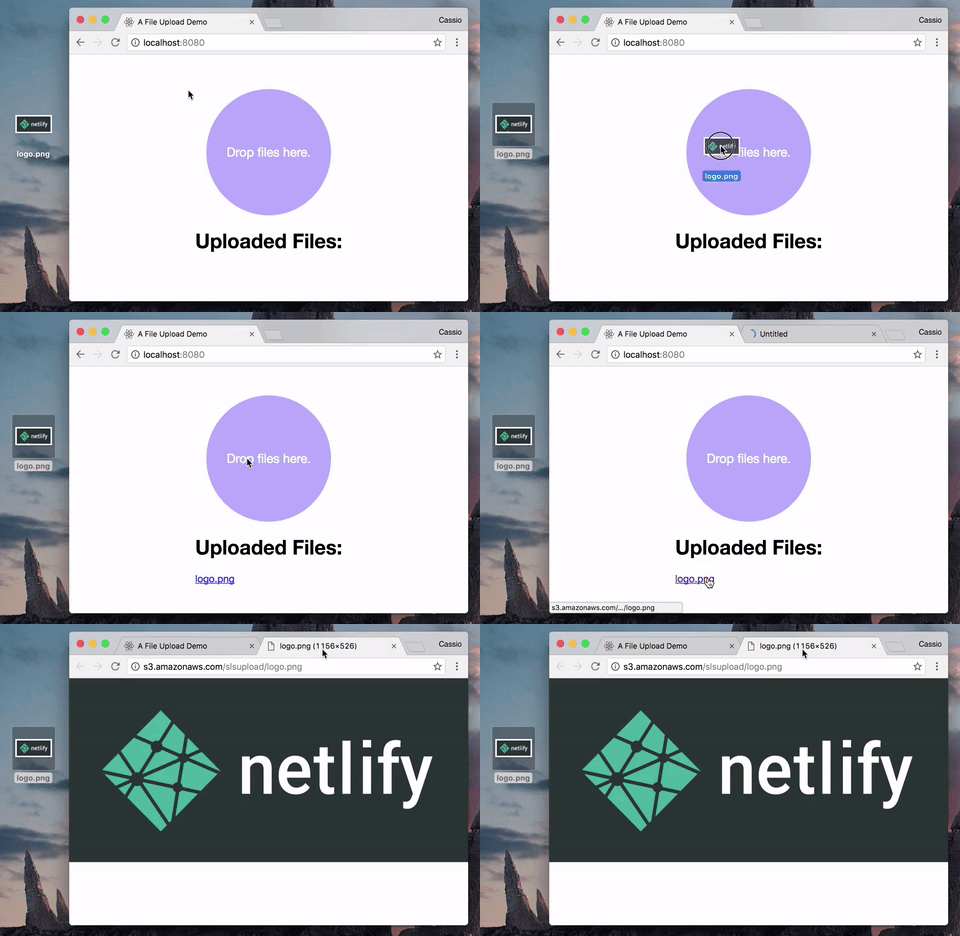
Web applications often crave the power to let users to upload files such as images, but e'er so frequently, this is the just functionality on the project that required an application server. Thousands of sites on the Internet could do good from a CDN infrastructure, but are currently hosted on slower and less secure infrastructure because of things like consumer pictures for a product page, resume uploads for the jobs folio etc... In this tutorial, yous will learn how to build a secure, serverless file upload system using the "serverless framework". If you're new to the serverless framework, bank check out our "Serverless Framework Tutorial": Part one and Role two. The ideal scenario from the point of view of performance and scalability would be to let your users to upload files directly to S3 (Uncomplicated Storage Service — a cloud storage service from AWS). It would be a highly scalable, reliable and fast solution that wouldn't consume whatsoever application server resources. Well, for obvious security reasons we can't just leave a S3 bucket wide open for anyone to upload anything on it — just what if we introduce in intermediary step, an API endpoint that our client application can call asking for "permission" for each new file upload? The API tin validate the asking (Is the request coming from our site? What type of file does it want to upload?) and then answer with a signed URL for a direct-to-s3 upload. Each returned URL is unique and valid for a unmarried usage, nether the specified weather. Having everything installed and setup, let's start by creating a new project: If everything goes right, you should see the usual success message, and your base project files will be created. Let'due south start by provisioning the S3 saucepan that will be used for the paradigm uploads. Edit the serverless.yml configuration and add a new resource. You lot demand to whitelist the allowed CORS methods and origins. For this tutorial we volition also let the files be publicly accessible (READ): Remember that Amazon employs a very strict access policy in information technology'southward services — by default your Lambda functions won't have permission to do anything with this S3 bucket. So, scroll upward the serverless.yml file to add a new IAM office in the Your complete serverless.yml file should expect like this: provider : functions : resources : At present nosotros'll create and configure the bodily lambda office and API endpoint. To begin with, we will need to install the aws-sdk package: Next, open the handler.js file and require the module: var AWS = require ( 'aws-sdk' ) ; On the requestUploadURL office handler, all we need to do is go an instance of You can check the complete list of available parameters for the Only these ii parameters are required, but in our example we volition crave the client to pass the name and type of the file they want to upload. Nosotros will so generate an upload URL valid but for that specific file type. Information technology'south too very common to inquire for file size to decide whether or not to allow for the upload, simply for simplicity we will skip this in our example. Bold the user will post a JSON with the file's proper name and type, here are the respective parameters for our var s3Params = { Side by side, we volition phone call Finally, we volition invoke the office callback returning the signed upload URL: Notice that we're restricting the service to requested only by "https://www.my-site.com". This is an additional condom measure, equally modern browsers won't let anyone initiate uploads originated on other domains. (If you desire, though, you can employ "*" to permit requests from any domain). The complete source code (Gist): var s3Params = { var uploadURL = s3. getSignedUrl ( 'putObject' , s3Params) ; callback ( null , { The last step is setting up your function with an HTTP endpoint. Back on serverless.yml, add this to your At present, to upload a file directly to S3, all your customer code needs to to is get-go inquire for an upload URL then submit the hulk straight to S3. For example, let'due south create a bare-bones elevate-n-drop file share: That's exactly what the sample lawmaking below does (Gist): <script type = "text/javascript" > function abolish ( due east ) { role handleDrop ( e ) { At that place it is: A highly scalable, serverless prototype upload service. This is just a basic implementation of the straight-to-s3 concept, merely you can use information technology as a base and further extend and customize to your needs (like saving all upload file names on database, for example).Straight-to-S3 File Uploads
The Serverless Projection
serverless create --template aws-nodejs --path imageupload`
Serverless: Creating new Serverless service... Serverless: Creating the service in "/Users/cassiozen/Desktop/imageupload" _______ __ | _ .-----.----.--.--.-----.----| .-----.-----.-----. | |___| -__| _| | | -__| _| | -__|__ --|__ --| |____ |_____|__| \___/|_____|__| |__|_____|_____|_____| | | | The Serverless Application Framework | | serverless.com, v1.0.2 -------' Serverless: Successfully created service with template: "aws-nodejs" Provisioning the Upload S3 Saucepan
                              # you can add together CloudFormation resource templates here
                resource                :
                Resources                :
                UploadBucket                :
                Type                :                AWS:                :S3:                :Bucket
                Properties                :
                BucketName                :                slsupload
                AccessControl                :                PublicRead
                CorsConfiguration                :
                CorsRules                :
                -                AllowedMethods                :
                -                Go
                -                PUT
                -                Mail
                -                Caput
                AllowedOrigins                :
                -                "*"
                AllowedHeaders                :
- "*" provider department:
                              provider                :
                name                :                aws
                runtime                :                nodejs4.3
                iamRoleStatements                :
                -                Issue                :                "Allow"
                Action                :
                -                "s3:*"
                Resources                :                "arn:aws:s3:::slsupload/*"
service : imageupload
name : aws
runtime : nodejs4.3
iamRoleStatements :
- Result : "Allow"
Activity :
- "s3:*"
Resources : "arn:aws:s3:::slsupload/*"
hullo :
handler : handler.hi
Resources :
UploadBucket :
Type : AWS: :S3: :Bucket
Properties :
BucketName : slsupload
AccessControl : PublicRead
CorsConfiguration :
CorsRules :
- AllowedMethods :
- GET
- PUT
- POST
- Head
AllowedOrigins :
- "*"
AllowedHeaders :
- "*"
requestUploadURL lambda part
npm install --relieve aws-sdk
'use strict' ; Role Handler
AWS.S3 and phone call getSignedUrl to generate the signed upload URL. The getSignedUrl method accepts two parameters:
putObject.putObject operation requires two parameters:
putObject operation on the official documentation page.putObject operation:
var s3 = new AWS.S3 ( ) ;
var params = JSON . parse (event.torso) ;
Saucepan : 'slsupload' ,
Key : params.name,
ContentType : params.blazon,
ACL : 'public-read' ,
} ; s3.getSignedUrl and store the returned upload url on a variable:
var uploadURL = s3. getSignedUrl ( 'putObject' , s3Params) ;
                              callback                (                null                ,                {
                statusCode                :                200                ,
                headers                :                {
                'Admission-Control-Allow-Origin'                :                'https://world wide web.my-site.com'
                }                ,
                body                :                JSON                .                stringify                (                {                uploadURL                :                uploadURL                }                )                ,
                }                )
module.exports. requestUploadURL = ( event, context, callback ) => {
var s3 = new AWS.S3 ( ) ;
var params = JSON . parse (consequence.trunk) ;
Bucket : 'slsupload' ,
Key : params.proper name,
ContentType : params.type,
ACL : 'public-read' ,
} ;
statusCode : 200 ,
headers : {
'Access-Control-Allow-Origin' : 'https://www.my-site.com'
} ,
body : JSON . stringify ( { uploadURL : uploadURL } ) ,
} )
} Part event configuration.
functions section:
                              functions                :
                requestUploadURL                :
                handler                :                handler.requestUploadURL
                events                :
                -                http                :
                path                :                requestUploadURL
                method                :                post
                cors                :                true
The sample customer file.
<! DOCTYPE html >
<html lang = "en" >
<caput >
<title > A File Upload Demo </title >
<style >
html, body {
pinnacle : 100%;
margin : 0;
}
body {
font-family unit : 'Helvetica Neue' , Helvetica, Arial, sans-serif;
}
.aligner {
height : 100%;
display : flex;
marshal-items : center;
justify-content : eye;
flex-direction : column;
}
#drop {
tiptop : 200px;
width : 200px;
border-radius : 100px;
color : #fff;
background-colour : #baf;
font-size : 20px;
display : flex;
align-items : center;
}
</style >
</head >
<torso >
<div class = "aligner" >
<div id = "drib" > Drop files hither. </div >
<div id = "list" >
<h1 > Uploaded Files: </h1 >
</div >
</div >
var drop = document. getElementById ( 'driblet' ) ;
var list = certificate. getElementById ( 'list' ) ;
var apiBaseURL = "https://74t3vol55c.execute-api.us-east-1.amazonaws.com/dev" ;
e. preventDefault ( ) ;
render imitation ;
}
due east. preventDefault ( ) ;
var dt = e.dataTransfer;
var files = dt.files;
for ( var i= 0 ; i<files.length; i++ ) {
var file = files[i] ;
var reader = new FileReader ( ) ;
reader. addEventListener ( 'loadend' , function ( east ) {
fetch (apiBaseURL+ "/requestUploadURL" , {
method : "POST" ,
headers : {
'Content-Blazon' : 'awarding/json'
} ,
body : JSON . stringify ( {
name : file.name,
type : file.type
} )
} )
. and then ( function ( response ) {
return response. json ( ) ;
} )
. then ( part ( json ) {
return fetch (json.uploadURL, {
method : "PUT" ,
trunk : new Blob ( [reader.consequence] , { type : file.type} )
} )
} )
. so ( function ( ) {
var uploadedFileNode = document. createElement ( 'div' ) ;
uploadedFileNode.innerHTML = '<a href="//s3.amazonaws.com/slsupload/' + file.name + '">' + file.proper name + '</a>' ;
list. appendChild (uploadedFileNode) ;
} ) ;
} ) ;
reader. readAsArrayBuffer (file) ;
}
return false ;
}
drop. addEventListener ( 'dragenter' , cancel) ;
drop. addEventListener ( 'dragover' , abolish) ;
drop. addEventListener ( 'drop' , handleDrop) ;
</body >
</html >
Source: https://www.netlify.com/blog/2016/11/17/serverless-file-uploads/
0 Response to "Android Aws Call Function When Upload Finished"
Post a Comment